
Blockchain technology has evolved far beyond its original association with cryptocurrency, transforming into a foundational infrastructure for modern enterprises. With global blockchain spending projected to reach $19 billion by 2024 and over 81% of major corporations exploring blockchain solutions, understanding its practical applications has become essential for business leaders navigating digital transformation.
Key Insights
– Enterprise blockchain market valued at $7.4 billion in 2023, growing at 42.5% CAGR through 2028
– 81% of Fortune 500 companies have blockchain initiatives in development or production
– Supply chain blockchain applications reduce administrative costs by up to 50%
– Healthcare blockchain solutions are projected to save $150 billion annually by 2025 through improved data interoperability
This guide examines how organizations across industries leverage blockchain to enhance transparency, security, and operational efficiency.
Understanding Blockchain Technology Fundamentals
Blockchain operates as a distributed ledger technology (DLT) that records transactions across multiple computers in a way that makes the records extremely difficult to alter retroactively. Each “block” contains transaction data, a timestamp, and a cryptographic hash connecting it to the previous block, creating an immutable chain.
Unlike traditional databases controlled by single entities, blockchain networks function through consensus mechanisms where participants validate transactions without requiring trusted intermediaries. This architectural difference fundamentally changes how businesses handle trust, verification, and data sharing.
The technology offers several distinguishing characteristics that drive its business value:
Immutability ensures that once data enters the blockchain, it cannot be modified without network consensus, creating verifiable audit trails for industries requiring rigorous compliance documentation.
Decentralization removes single points of failure, distributing data across network participants rather than storing it in vulnerable central servers.
Transparency allows authorized participants to view transaction histories, reducing disputes and enabling real-time verification of claims, supply chain provenance, or ownership records.
Smart contracts are self-executing programs stored on the blockchain that automatically enforce agreement terms when predetermined conditions are met, eliminating manual processing and reducing fraud risk.
These capabilities explain why blockchain adoption has accelerated beyond financial services into healthcare, supply chain management, real estate, and government operations.
Industries Revolutionized by Blockchain Applications
Supply Chain Management and Logistics
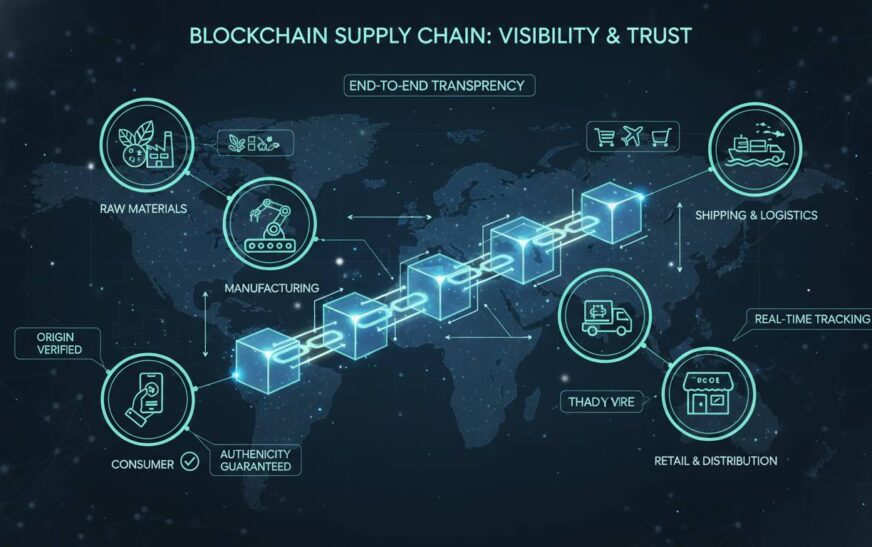
Supply chain visibility represents one of blockchain’s most immediate business value propositions. Companies increasingly face consumer and regulatory demands for proof of origin, ethical sourcing, and authentic handling of products. Blockchain creates unbroken digital records tracking items from raw materials to final delivery.
Walmart’s implementation demonstrates measurable impact. After implementing IBM Food Trust for leafy greens traceability, the company reduced the time needed to track produce origin from 7 days to 2.2 seconds. This capability proved invaluable during food safety investigations, enabling rapid isolation of contaminated sources.
Maersk, the global shipping giant, partnered with IBM to develop TradeLens, a blockchain-enabled shipping solution processing over 150 million events monthly. The platform eliminated redundant documentation, reduced shipping delays caused by paperwork errors, and enabled real-time visibility across complex multi-modal transport routes.
BHP applied blockchain to track mineral samples throughout the mining process, reducing disputes between field teams and laboratory operators while ensuring analytical integrity. The immutable record of sample handling transformed what previously required extensive manual reconciliation into automated verification.
These implementations share common characteristics: multiple parties requiring shared data, complex multi-step processes prone to errors, and regulatory or customer demands for provenance verification.
Financial Services Transformation
The financial sector continues experiencing blockchain’s most visible disruption through both traditional enterprise adoption and decentralized finance (DeFi) innovations.
JPMorgan’s Onyx (formerly Quorum) processes over $1 trillion in daily transactions for institutional clients, enabling real-time settlement of interbank transfers that traditionally required overnight processing. The platform demonstrates how private, permissioned blockchains serve enterprise needs differently from public cryptocurrency networks.
Visa processed over $3 billion in blockchain-based transactions in 2023, leveraging stablecoin settlement for cross-border payments that traditionally required 2-5 business days. By settling transactions in USDC stablecoin, Visa enables same-day settlement with reduced foreign exchange friction.
Insurance companies apply blockchain to streamline claims processing and reduce fraud. AXA deployed Fizzy, a blockchain-powered flight delay insurance product that automatically triggers payouts when verified delay data appears on airline systems, eliminating manual claims submission and approval processes.
The World Bank issued its first blockchain-based bond in 2018, followed by multiple sovereign debt issuances leveraging distributed ledger technology for faster settlement and reduced intermediary costs. This institutional validation signals growing acceptance of blockchain as infrastructure for traditional capital markets.
Healthcare and Medical Records
Healthcare faces persistent challenges with data fragmentation across providers, patient identity management, and clinical trial verification. Blockchain addresses these issues through secure, patient-controlled health information sharing.
MedRec, developed by researchers at MIT, demonstrates how blockchain can create unified medical record systems granting patients comprehensive access to their histories while maintaining granular permission controls. Patients determine which providers view specific records, addressing privacy concerns while enabling care continuity.
Clinical trial verification represents another high-value application. Pfizer and other pharmaceutical companies explored blockchain solutions to create tamper-proof records of trial protocols, enrollment criteria, and outcome data. These immutable records address concerns about data manipulation while enabling regulatory verification.
The U.S. Department of Health and Human Services has funded multiple blockchain pilot programs exploring health data exchange, insurance eligibility verification, and provider credentialing. While widespread adoption remains limited by interoperability challenges and regulatory complexity, the directional momentum toward blockchain-based health infrastructure continues.
Enterprise Implementation Strategies
Organizations approaching blockchain implementation benefit from structured evaluation frameworks distinguishing genuine opportunities from technology looking for problems.
Assessment Criteria for Blockchain Suitability
Not every business problem requires blockchain. The technology proves most valuable when specific conditions exist:
Multi-party data sharing creates the strongest case for blockchain. When multiple organizations need consistent, verified data without trusting a single party to maintain records, distributed ledger architecture provides inherent advantages over centralized databases requiring complex reconciliation.
Transaction verification requirements favor blockchain when parties lack pre-existing trust relationships and third-party verification adds unacceptable cost or delay. Smart contracts can replace escrows, letters of credit, and manual approval workflows.
Immutable audit trails matter most in highly regulated industries where compliance documentation must withstand legal scrutiny. Blockchain’s cryptographic verification exceeds traditional audit approaches for many use cases.
Process automation across boundaries becomes possible when smart contracts coordinate actions between organizations that cannot integrate their internal systems. Cross-border trade, supply chain handoffs, and multi-party agreements often present these scenarios.
Implementation Approaches
Consortium blockchains involve multiple organizations governing a shared network, distributing control while enabling collaboration. TradeLens, Food Trust, and similar industry-specific platforms follow this model, offering standardized protocols without requiring competitors to share sensitive internal data.
Private blockchains serve single-organization deployments where the technology’s efficiency, audit, and smart contract benefits apply without external participant requirements. These implementations sacrifice decentralization benefits but gain performance and control advantages.
Layer 2 solutions address scalability limitations of primary blockchain networks, enabling higher transaction throughput for specific applications while leveraging the underlying network’s security properties. Payment processing and supply chain tracking often employ layer 2 architectures.
Enterprise implementations increasingly favor established platforms including Hyperledger Fabric, R3 Corda, and Polygon PoS rather than building custom blockchain infrastructure, reducing development costs while benefiting from community security auditing.
Common Implementation Mistakes to Avoid
Organizations frequently stumble on predictable challenges during blockchain adoption, and understanding these pitfalls improves project success rates.
Overlooking integration complexity derails many initiatives. Blockchain doesn’t operate in isolation—it must exchange data with existing enterprise systems, often requiring significant middleware development and process reengineering. Projects underestimating integration effort exceed budgets and timelines consistently.
Choosing public over private inappropriately creates unnecessary challenges. Public blockchains offer maximum decentralization but introduce performance limitations, unpredictable costs, and privacy concerns inappropriate for many enterprise scenarios. Organizations sometimes choose public networks seeking credibility while their actual use cases favor private alternatives.
Failing to establish governance leaves blockchain networks without decision-making frameworks for dispute resolution, protocol upgrades, and participant admission. Technology implementation without clear governance produces networks that stall after initial deployment.
Neglecting regulatory uncertainty exposes organizations to compliance risks as blockchain regulations continue evolving. Different jurisdictions classify blockchain assets and activities variously, and cross-border implementations require careful legal analysis.
Future Outlook: Blockchain’s Evolving Business Role
The blockchain landscape continues maturing toward enterprise readiness, with several trends shaping future adoption trajectories.
Interoperability protocols are enabling communication between previously siloed blockchain networks. Cross-chain bridges and protocols like Polkadot and Cosmos facilitate data and asset transfer across different blockchain architectures, addressing a fundamental limitation of early implementations.
Central Bank Digital Currencies (CBDCs) are driving government adoption, with over 130 countries exploring or piloting digital currency programs. China’s digital yuan has processed over $14 billion in transactions, while the Bahamas’ Sand Dollar serves as a fully operational CBDC. These government initiatives will normalize blockchain-based transactions and potentially create new infrastructure standards.
Tokenization of real-world assets is expanding blockchain beyond digital-native applications. Real estate, artwork, commodity contracts, and company equity increasingly exist as blockchain tokens, enabling fractional ownership and secondary market trading previously impossible for these asset classes.
Decentralized identity solutions are emerging as blockchain addresses long-standing digital identity challenges. Self-sovereign identity systems enable individuals to control credential presentation rather than relying on centralized identity providers, with implications for authentication, regulatory compliance, and data privacy.
Enterprise blockchain adoption has passed early enthusiasm and skepticism phases, settling into practical implementation where demonstrated value justifies continued investment. Organizations approaching blockchain as infrastructure rather than novelty positioning achieve more sustainable outcomes.
Frequently Asked Questions
What industries benefit most from blockchain technology currently?
Supply chain management, financial services, and healthcare demonstrate the strongest blockchain value propositions. Supply chain applications provide immediate ROI through provenance verification and reduced manual reconciliation. Financial services leverage blockchain for settlement efficiency, cross-border payments, and smart contract automation. Healthcare benefits from patient data portability and clinical trial verification, though regulatory complexity slows adoption.
How does blockchain improve supply chain transparency?
Blockchain creates immutable transaction records tracking products from origin through every handling step. Each participant—manufacturers, shippers, warehouses, retailers—adds verified data to the shared ledger, creating complete visibility without relying on single-party record keeping. This transparency enables rapid contamination source identification, authenticity verification for luxury goods, and ethical sourcing documentation.
Are blockchain and cryptocurrency the same thing?
No—cryptocurrency represents one application of blockchain technology, but blockchain capabilities extend far beyond digital currencies. Enterprise blockchain implementations typically don’t involve cryptocurrency at all, instead using private networks with controlled access. Blockchain supports supply chain tracking, identity management, smart contracts, and decentralized applications unrelated to money transfer.
What is the main barrier to enterprise blockchain adoption?
Integration with existing systems represents the primary implementation challenge. Blockchain must exchange data with enterprise resource planning, customer relationship management, and legacy databases—requiring substantial development effort. Additionally, unclear regulatory frameworks and lack of standardized governance models create uncertainty for large-scale deployments.
How do smart contracts work in business applications?
Smart contracts are self-executing programs stored on the blockchain that automatically enforce agreement terms when conditions are met. For example, a shipping smart contract might release payment to the carrier automatically once blockchain-verified arrival data appears, eliminating manual invoice processing. This automation reduces disputes, speeds settlement, and removes intermediary dependencies.
Is blockchain technology environmentally sustainable?
Environmental concerns primarily apply to proof-of-work consensus mechanisms used by networks like Bitcoin. Enterprise blockchains typically employ proof-of-stake or permissioned consensus protocols consuming minimal energy—comparable to traditional database operations. Ethereum’s 2022 transition to proof-of-stake reduced its energy consumption by approximately 99.95%, addressing many environmental critiques.