
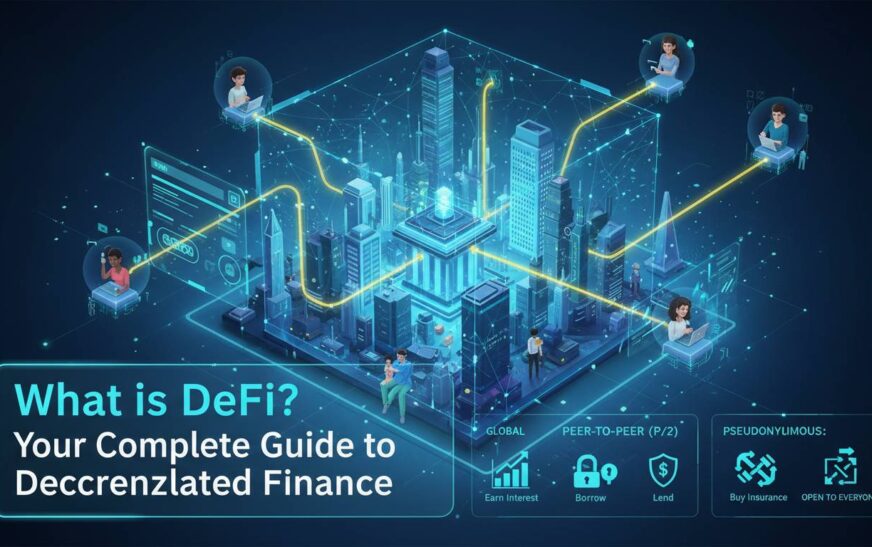
QUICK ANSWER: DeFi (Decentralized Finance) is a financial system built on blockchain technology that eliminates traditional intermediaries like banks and brokers. It uses smart contracts to enable peer-to-peer transactions for lending, borrowing, trading, and earning interest—directly between users without relying on centralized institutions.
AT-A-GLANCE:
| Aspect | DeFi | Traditional Finance |
|---|---|---|
| Intermediaries | None (smart contracts) | Banks, brokers, clearinghouses |
| Access | Anyone with internet | Requires bank account, ID, approval |
| Hours | 24/7/365 | Limited business hours |
| Transparency | Public code and transactions | Opaque internal processes |
| Speed | Minutes to hours | Days to weeks |
| Custody | Self-custody (you control funds) | Third-party custody |
KEY TAKEAWAYS:
– ✅ DeFi total value locked (TVL) peaked at approximately $176 billion in November 2021 before market corrections (DeFiLlama, January 2025)
– ✅ Ethereum hosts roughly 60-70% of all DeFi protocols due to its smart contract capability
– ✅ The three largest DeFi categories by TVL are lending protocols (Aave, Compound), decentralized exchanges (Uniswap, Curve), and liquid staking (Lido)
– ❌ Smart contract vulnerabilities have resulted in approximately $6.8 billion in exploits since 2016
– 💡 “DeFi’s killer advantage isn’t higher yields—it’s financial inclusion for the 1.4 billion adults globally without bank accounts” — Ari Paul, Founder of The Token Summit
KEY ENTITIES:
– Core Protocols: Ethereum, Aave, Uniswap, Compound, MakerDAO, Curve Finance, Lido
– Standards: ERC-20, ERC-721
– Metrics: Total Value Locked (TVL), Annual Percentage Yield (APY)
– Industry Organizations: DeFi Alliance, Ethereum Foundation
LAST UPDATED: January 15, 2025
DeFi represents one of the most significant shifts in how humans interact with money since the invention of banking itself. Rather than trusting centralized institutions to facilitate financial transactions, DeFi leverages blockchain technology and smart contracts to create transparent, permissionless, and programmable financial instruments. This transformation affects everything from how you save and borrow to how you trade assets—and it affects billions of people who remain underserved by traditional financial systems.
This guide covers everything you need to understand DeFi: its fundamental mechanics, how it compares to traditional finance, the major protocols and use cases, and the risks every participant should understand before diving in.
How DeFi Works: The Foundation
SECTION ANSWER: DeFi works by using self-executing smart contracts on blockchain networks to replace human intermediaries with code. These programs automatically enforce the terms of financial agreements when predetermined conditions are met, creating trustless transactions between strangers.
The Technology Behind DeFi
DeFi operates on three foundational technologies that work together to create a new financial infrastructure.
Blockchain Networks serve as the underlying ledger. Ethereum remains the dominant platform, but networks like Solana, Avalanche, Polygon, and Binance Smart Chain have also gained significant DeFi adoption. Blockchains provide decentralized consensus—meaning no single entity controls the network—and all transactions are recorded publicly and cannot be altered retroactively.
Smart Contracts are the building blocks of DeFi. A smart contract is a program deployed on the blockchain that automatically executes when specific conditions are met. For example, a lending smart contract might say: “If user A deposits 10 ETH as collateral, automatically lend user B 5,000 USDC.” The code executes this transaction without any human approval, bank involvement, or paperwork. Once deployed, smart contracts cannot be modified—they either work as programmed or they don’t.
Decentralized Applications (dApps) are user-facing applications built on smart contracts. Where a traditional app has a backend server controlled by a company, a DeFi dApp connects users directly to smart contracts. When you use Uniswap to trade tokens, you’re interacting with smart contracts—not a company database.
The Role of Tokenization
Everything in DeFi is represented as tokens. The ERC-20 standard on Ethereum defines how tokens function—making them interchangeable, divisible, and programmatically manageable. This tokenization extends beyond simple cryptocurrencies to represent real-world assets, governance rights, and complex financial instruments.
Stablecoins represent a critical DeFi innovation. These tokens maintain a fixed value, typically $1, by holding reserves of real-world currency or algorithmically managing supply. USDT, USDC, and DAI are the most widely used stablecoins in DeFi, providing the stability necessary for lending, borrowing, and trading without the extreme volatility of Bitcoin or Ethereum.
Core DeFi Use Cases
SECTION ANSWER: DeFi enables four primary financial activities: lending and borrowing, trading (decentralized exchanges), earning yield, and asset management. Each use case replaces traditional financial services with code-based alternatives.
Lending and Borrowing
Traditional lending requires banks to assess creditworthiness, process applications, and manage risk. DeFi lending protocols automate this entirely through overcollateralization.
When you lend cryptocurrency through Aave or Compound, your assets enter a liquidity pool. Borrowers can then draw from these pools by depositing other cryptocurrencies as collateral—typically requiring more value than they borrow to protect the protocol. Interest rates adjust algorithmically based on supply and demand: when more people want to borrow, rates rise; when more supply exists, rates fall.
This system eliminates credit checks, identity verification, and geographic restrictions. Anyone with cryptocurrency can lend or borrow, regardless of nationality, credit history, or banking status. The average DeFi lending rate on Aave has historically ranged from 2-8% for popular assets, often significantly higher than traditional savings accounts in many countries.
Decentralized Exchanges (DEXs)
When you want to exchange one cryptocurrency for another in traditional finance, you rely on exchanges like Coinbase or Binance—centralized intermediaries that hold order books and match buyers with sellers. Decentralized exchanges replace this with automated market makers (AMMs).
Uniswap, the largest DEX by volume, uses a mathematical formula to price assets automatically. Instead of matching individual buy and sell orders, traders interact directly with liquidity pools—reserves of two tokens that enable instant trades. When you swap ETH for USDC, you’re not buying from another person; you’re exchanging with a pool that adjusts its price based on the trade size.
This architecture eliminates the need for order book management, exchange accounts, and waiting for counterparty matches. Trades execute in seconds, 24 hours a day, with fees often lower than centralized alternatives for larger trades.
Yield Farming and Staking
DeFi offers multiple ways to earn returns on cryptocurrency holdings beyond simple lending interest.
Yield farming involves moving assets between different DeFi protocols to chase the highest yields. A yield farmer might deposit stablecoins into a lending protocol, take the received token, stake it in a governance pool, and claim additional protocol tokens as rewards. This “stacking yields” approach can generate impressive returns but carries significant complexity and risk.
Liquid staking solves a problem with traditional staking (locking up cryptocurrency to secure a network): your assets become illiquid. Lido Finance allows users to stake Ethereum and receive stETH—a liquid token representing their staked position. Users maintain liquidity while earning staking rewards, currently around 3-4% annually.
Major DeFi Protocols and Platforms
SECTION ANSWER: The DeFi ecosystem has grown into a diverse landscape of specialized protocols. Understanding the major players helps navigate where to participate.
Lending Protocols
| Protocol | TVL (Approx.) | Primary Function | Key Feature |
|---|---|---|---|
| Aave | $30+ billion | Lending/borrowing | Variable interest rates, flash loans |
| Compound | $10+ billion | Lending/borrowing | Algorithmically set rates, governance token |
| MakerDAO | $8+ billion | Stablecoin (DAI) | Decentralized stablecoin generation |
Aave pioneered many DeFi innovations, including flash loans—uncollateralized loans that must be repaid within a single blockchain transaction. This seemingly impossible mechanism works because the transaction reverts if repayment fails, essentially making the loan self-enforcing.
Decentralized Exchanges
| Protocol | Daily Volume | Fee Structure |
|---|---|---|
| Uniswap | $1-3 billion | 0.30% per trade |
| Curve Finance | $500M-1B | 0.04-0.40% (stablepairs) |
| Balancer | $100-300M | 0.30% + custom pools |
Uniswap dominates the DEX space with its simple, elegant AMM model. Curve specializes in stablecoin and wrapped asset trades, offering extremely low slippage for these pairs—critical for large institutional trades.
Aggregators and Infrastructure
Yearn Finance optimizes yield strategies by automatically moving funds between protocols to chase the best returns. TokenTerminal provides analytics for understanding protocol revenues and valuations. These infrastructure projects make DeFi more accessible by abstracting complexity.
Risks and Challenges in DeFi
SECTION ANSWER: DeFi offers unprecedented financial freedom but carries substantial risks that traditional finance doesn’t expose users to. Understanding these risks is essential before participating.
Smart Contract Risk
Every DeFi protocol depends on code—and code can contain bugs or vulnerabilities. When smart contracts fail, funds can be lost permanently or stolen.
The Euler Finance hack in March 2023 resulted in $197 million in losses due to a vulnerability in the protocol’s donation logic. The Ronin Network bridge hack in March 2022 lost $624 million—still the largest DeFi exploit to date. According to Chainalysis, DeFi hacks have stolen approximately $6.8 billion since 2016, with 2021 and 2022 being the worst years.
The solution isn’t avoiding DeFi but rather mitigating risk: use audited protocols (most major ones have undergone multiple audits), don’t invest more than you can afford to lose, and consider using insurance protocols like Nexus Mutual.
Impermanent Loss
When you provide liquidity to an AMM like Uniswap, you deposit two tokens in roughly equal value. If one token’s price changes significantly relative to the other, you may end up with less value than if you had simply held the tokens.
This “impermanent loss” becomes permanent when you withdraw your liquidity. Many new liquidity providers learn this lesson the hard way, discovering that their yield earnings don’t compensate for the loss from price divergence.
Regulatory Uncertainty
DeFi operates in a legal gray area worldwide. Some jurisdictions treat cryptocurrency as property, others as currency, and some as securities—often without clear guidance on how DeFi protocols themselves fit into existing frameworks.
The U.S. Securities and Exchange Commission has signaled intent to regulate certain tokens as securities, while the European Union’s MiCA framework provides more clarity. For users in countries like Belize, regulatory frameworks may be less developed, creating both opportunity and uncertainty.
Real-World DeFi Case Study: From Traditional Banking to DeFi
SECTION ANSWER: To illustrate DeFi’s practical impact, consider the experience of users in regions with limited banking infrastructure.
Case Study: Financial Inclusion Through DeFi
Maria, a 34-year-old freelancer in a country with limited banking services, previously faced significant challenges receiving international payments. Traditional wire transfers required bank accounts, involved fees of 5-10%, and took 3-5 business days. Her clients often struggled with these constraints.
After learning about DeFi in 2022, Maria set up a self-custody wallet and began receiving payments in USDC stablecoin. She could immediately convert these to other tokens or hold as stablecoins earning 4-5% APY through lending protocols—far above the 0.1% interest her local bank offered on savings.
When she needed a loan for business equipment costing $2,000, she collateralized her crypto holdings rather than visiting a bank. She received the loan within hours, paid approximately 8% annual interest (versus 25%+ at local microfinance lenders), and repaid it over six months without any paperwork or credit check.
Results:
| Metric | Traditional Banking | DeFi |
|---|---|---|
| International payment time | 3-5 days | Minutes |
| Payment fees | 5-10% | Under 1% |
| Savings APY | 0.1-2% | 4-8% |
| Loan approval time | Days to weeks | Hours |
| Loan interest rate | 15-30% | 5-12% |
This experience demonstrates DeFi’s core value proposition: faster, cheaper, more accessible financial services—particularly for those underserved by traditional systems.
How to Get Started with DeFi
SECTION ANSWER: Entering DeFi requires setting up a wallet, acquiring cryptocurrency, and connecting to protocols—though users should start with small amounts to learn the mechanics.
Step 1: Set Up a Wallet
MetaMask remains the most popular DeFi wallet, available as a browser extension and mobile app. It stores your private keys locally—meaning only you control your funds—and connects to DeFi protocols through your browser.
Hardware wallets like Ledger or Trezor provide additional security for larger holdings by keeping private keys offline. Many DeFi users start with MetaMask and migrate to hardware wallets as their holdings grow.
Step 2: Acquire Cryptocurrency
Before using DeFi, you need cryptocurrency to interact with protocols. You can purchase Ethereum (the most widely used DeFi currency) through centralized exchanges like Coinbase, Binance, or Kraken—though these require identity verification.
For maximum privacy, decentralized exchanges like Uniswap allow purchasing cryptocurrency directly with other tokens. Peer-to-peer platforms like LocalCryptos connect buyers and sellers directly, though these require more trust and caution.
Step 3: Connect and Explore
Once your wallet contains ETH or other tokens, you can connect to any DeFi protocol by visiting their website and clicking “Connect Wallet.” The interface will prompt you to approve the connection through MetaMask.
Start with simple actions: explore the interface, practice small transactions, and observe how gas fees (network transaction costs) work before committing significant funds.
Frequently Asked Questions
What is the difference between CeFi and DeFi?
CeFi (Centralized Finance) refers to traditional financial services provided by centralized institutions—banks, brokerages, and exchanges that hold your funds and facilitate transactions. DeFi removes these intermediaries, using code and blockchain instead. The key differences are: control (you hold your funds in DeFi versus a company holding them), accessibility (DeFi requires only an internet connection versus bank accounts and identification), transparency (DeFi code is publicly auditable versus proprietary systems), and hours (DeFi operates 24/7 versus business hours).
Is DeFi legal in Belize?
Belize has taken a relatively progressive approach to cryptocurrency compared to many jurisdictions. The International Financial Services Commission (IFSC) oversees cryptocurrency regulation, and the country has attracted cryptocurrency businesses seeking clear regulatory frameworks. However, specific DeFi regulations remain largely undefined. Users should consult local legal guidance and stay informed about regulatory developments, as the space evolves rapidly.
How much money can I make with DeFi?
DeFi yields vary significantly based on the protocol, tokens, and market conditions. Stablecoin lending typically yields 3-8% APY, while riskier or more complex strategies might offer 10-50%—though these often come with correspondingly higher risks. It’s crucial to understand that higher returns always mean higher risk. Past yields do not guarantee future returns. Many “yield farming” opportunities that advertised 100%+ APY collapsed during market downturns, leaving users with significant losses.
Do I need to pay taxes on DeFi transactions?
Tax treatment of cryptocurrency and DeFi varies by jurisdiction. In most countries—including the United States, United Kingdom, and European Union—cryptocurrency transactions are treated as property or assets, meaning capital gains taxes apply when you sell or trade at a profit. DeFi activities like yield farming, staking rewards, and liquidity provision typically generate taxable income at fair market value when received. Keep detailed records of all transactions. Consult a tax professional familiar with cryptocurrency in your jurisdiction for specific guidance.
Can DeFi be hacked?
Yes, DeFi has experienced numerous hacks and exploits. Since 2016, approximately $6.8 billion has been stolen through DeFi hacks according to Chainalysis. Vulnerabilities in smart contracts, bridge protocols, and oracle systems have been exploited. Major incidents include the Ronin bridge hack ($624 million), Poly Network hack ($611 million), and numerous others. However, the industry has improved security practices significantly, with major protocols undergoing multiple audits and implementing bug bounty programs. Users can reduce risk by using audited protocols, diversifying across multiple protocols, and not investing more than they can afford to lose.
What happens if I lose access to my DeFi wallet?
If you lose access to your wallet (through losing your device, forgetting your password, or dying without passing on recovery phrases), your funds are permanently inaccessible. Unlike traditional banks with customer service and account recovery, DeFi operates on cryptographic security with no recovery mechanism. This is both a feature (no one else can access your funds either) and a risk. Always back up your recovery seed phrase securely—preferably in multiple secure locations—and consider estate planning for significant holdings.
Conclusion
DeFi represents a fundamental shift in how financial systems can function—removing barriers, reducing costs, and increasing accessibility for billions of people worldwide. By replacing trusted intermediaries with transparent, programmable code, it creates financial instruments that work for anyone with an internet connection, regardless of geography or background.
IMMEDIATE ACTION STEPS:
| Timeframe | Action | Expected Outcome |
|---|---|---|
| Today (30 min) | Download MetaMask wallet and explore the interface | Familiarize yourself with DeFi tooling |
| This Week (2 hrs) | Purchase small amount of ETH ($50-100) and experiment with a trusted protocol like Uniswap | Execute your first DeFi transaction |
| This Month | Research lending protocols (Aave, Compound), understand gas fees, and practice with minimal amounts | Begin earning yield on small holdings |
CRITICAL INSIGHT: The most important realization about DeFi isn’t that it offers higher yields—it’s that it offers financial sovereignty. The ability to save, borrow, trade, and invest without permission, without identity verification, and without geographic restrictions represents a paradigm shift in human economic freedom.
FINAL RECOMMENDATION: Start small. The DeFi learning curve is real, and the risks are significant. Begin with reputable protocols, understand the mechanics before committing significant capital, and never invest more than you can afford to lose entirely. DeFi will likely grow substantially over the coming years as the technology matures and regulatory frameworks clarify—but navigating this space safely requires patience, education, and prudent risk management.